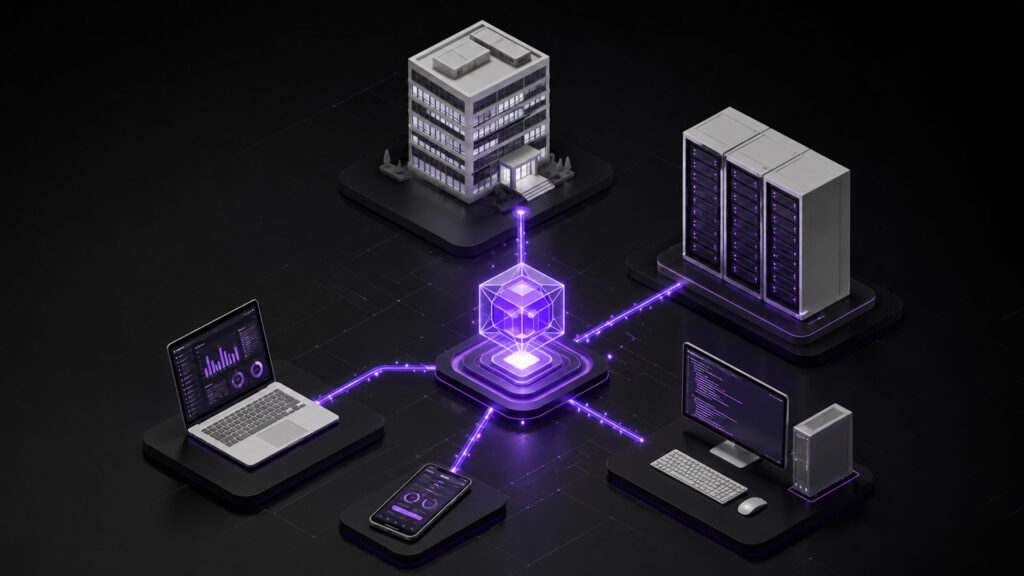

The transition to a Zero Trust model is reshaping security in data exchange platforms and B2B environments, especially in sensitive sectors such as finance and banking.
These organizations manage complex systems and high volumes of sensitive data. As a result, they require a security approach capable of mitigating modern threats, ensuring regulatory compliance (including NIS2 and DORA in Europe), and protecting real-time data flows.
In this context, Zero Trust stands out as the most effective architecture to secure both internal and external communications.
Why is Zero Trust important in Data Exchange and B2B environments?
Data exchange platforms process large volumes of critical information. Consequently, they are prime targets for cyberattacks.
For financial institutions, data exposure leads not only to reputational damage and financial losses, but also to severe regulatory penalties.
Zero Trust strengthens infrastructure by ensuring that every transaction and every access request is fully authenticated, authorized, and continuously monitored.
This approach is especially relevant in banking. Personal and transactional data must be protected with the highest level of integrity while complying with strict regulations such as NIS2 and DORA in Europe, as well as equivalent frameworks in the United States and Latin America.
How does Zero Trust work?
Zero Trust is built on a simple principle: never trust, always verify.
Every user or device requesting access is treated as a potential risk. This applies whether they are inside or outside the organization’s perimeter.
Instead of granting implicit trust to internal systems, Zero Trust applies granular control policies based on identity, context, and behavior.
Its foundation includes:
- Network segmentation
- Continuous authentication
- Multi-factor authentication (MFA) for sensitive environments
- Encryption of data in transit and at rest
Together, these controls reduce the attack surface and limit lateral movement.
Core Principles of Zero Trust
- Continuous verification: Every access request is evaluated using multiple factors, including identity and behavioral patterns.
- Least privilege access: Users receive only the permissions strictly necessary to perform their role.
- Context-based security: Access decisions consider device type, geographic location, and time of access.
- Continuous monitoring: User activity is tracked to detect anomalies and potential threats in real time.
Pillars of the Zero Trust model
- Identity and authentication: Only verified users gain access, supported by MFA and secure authentication protocols.
- Network segmentation: Infrastructure is divided into controlled segments to isolate critical assets.
- Data protection: Encryption protects information both in transit and at rest.
- Visibility and analytics: Continuous monitoring enables early detection of suspicious activity.
- Automation and orchestration: Policies adapt dynamically, and incident response becomes faster and more consistent.
Regulatory Compliance with Zero Trust: NIS2, DORA, and International Regulations
Regulations such as NIS2 and DORA require financial institutions to maintain resilient infrastructures capable of resisting cyberattacks.
Zero Trust supports these obligations by enforcing strict control over data access and movement. It also facilitates compliance across Europe and the Americas.
Moreover, its flexibility allows organizations to adapt security policies to regional regulatory requirements.
Implementing Zero Trust in MFT and Secure Data Exchange
To apply Zero Trust effectively in Managed File Transfer (MFT) and secure integration environments, organizations should focus on:
- Strong user and device authentication (MFA, biometrics, token-based systems)
- Advanced encryption (AES-256) for data in transit and at rest
- Segmentation of sensitive areas and isolation of DMZ zones
- Continuous monitoring and real-time threat detection
- Context-based access controls with automated incident response
These measures ensure secure, controlled, and traceable data transfers.
Securing Financial Data Exchange with Zero Trust
Adopting Zero Trust is essential for protecting financial data exchange platforms and B2B ecosystems.
At Neverhack, we specialize in designing and implementing Zero Trust strategies tailored to complex regulatory environments. We help organizations protect critical assets through scalable and customized security architectures.
Our managed services reinforce Zero Trust principles over time, ensuring continuous compliance and protection against emerging threats.
If you would like to explore how Zero Trust can strengthen your data exchange environment, feel free to contact us.