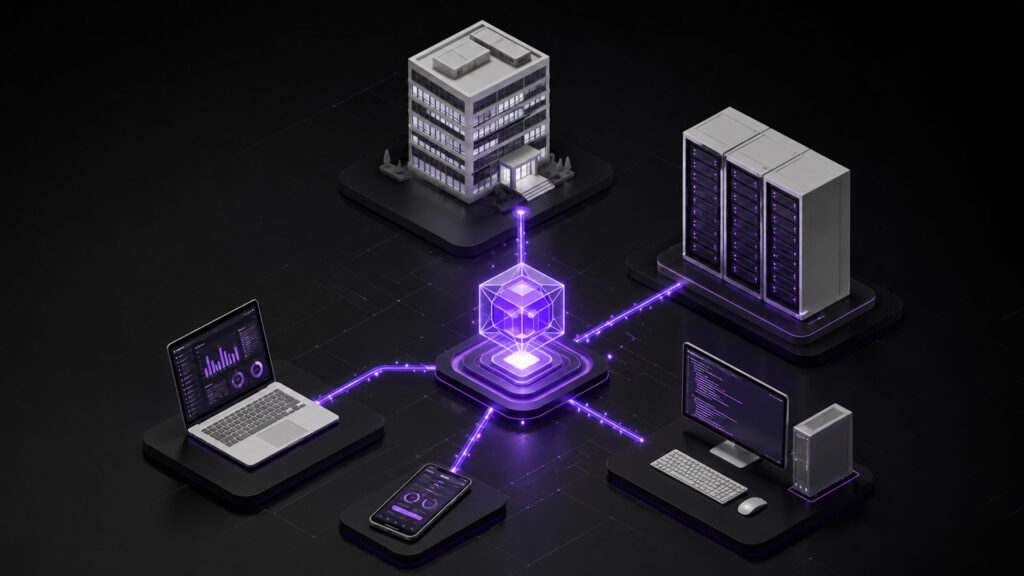

A strategic map of the security architecture converging around SASE, CNAPP and Agentic AI.
Walk into a corporate boardroom and the security posture looks reassuring. There is a firewall. There is a SOC, there is endpoint protection. Then someone points out that a growing share of enterprise traffic no longer flows between humans and applications, but between autonomous AI agents and other machines, acting on behalf of those same humans. Much of that traffic is invisible to the current stack. The perimeter you spent a decade hardening has shifted again, quietly.
The 2025-2026 cycle is not another round of best-of-breed tooling. It is the structural fusion of three architectures that grew up separately: Secure Access Service Edge (SASE) at the network layer, Cloud-Native Application Protection Platform (CNAPP) at the workload layer, and a new category of AI-specific controls at the agent and model layer. What follows is the map in six chapters: how these layers are converging, why each step is technically inevitable, and what each one asks of anyone planning the next 18 months of security investment.
1. The single-pass edge: how SASE ended the backhaul era
The foundation of the 2025-2026 strategy is the unified SASE model, where core network and security functions are delivered through a distributed cloud infrastructure. Instead of forcing traffic back to a central data center, where Secure Web Gateway, CASB, Firewall-as-a-Service and DLP are chained in series, the platform evaluates each flow once, at a globally distributed Point of Presence, against a single policy and a single TLS certificate chain.
The technical density matters. Single-pass means a packet is decrypted, classified, inspected at Layer 7, checked against identity and device posture, and re-encrypted in one operation. The legacy chained approach required up to seven separate inspection steps, each with its own latency, its own certificate management, and a new opportunity for policy drift across different consoles. Once those steps are collapsed, three things happen at once: latency drops below the user’s perception threshold, policy inconsistencies between tools disappear and TLS decryption stops being a fragmented process. Performance, in this model, is a security feature rather than a trade-off.
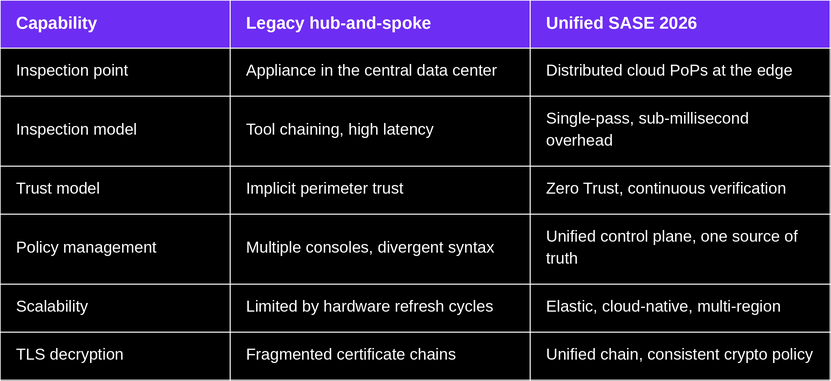
Table 1. Architectural transition to unified SASE
Strategic implication. If your security stack still slows users down, you are paying for both the latency and the workarounds. The decision is no longer which best-of-breed tool to add, but which platform you are consolidating on, and what is the cost of remaining fragmented for another budget cycle.
2. The end of the VPN: universal ZTNA and the invisible network
By 2025, the majority of new remote-access deployments were already Zero Trust Network Access rather than VPN. The structural flaw of a VPN is well known: once the tunnel is up, the user gets broad network access, and any compromised endpoint becomes a pivot for lateral movement. ZTNA inverts the model, creating micro-tunnels to individual applications and never to the network itself.
The corporate firewall stays in a permanent state of total denial for inbound traffic, and the infrastructure becomes a Dark Cloud: invisible to unauthorized users, impossible to enumerate, structurally hostile to reconnaissance.
The hard problem that early ZTNA solutions struggled with was non-web, bi-directional traffic such as RDP, SSH and database thick clients. That gap is now closed through reverse-access connectors: the component beside the application opens all of its connections outbound towards the broker, so the firewall protecting that application never has to allow an inbound port. Legacy applications can be wrapped in a Zero Trust envelope without rewriting a line of code.
The result is a single policy framework applied to every user, device and location, with predictable latency over a global private backbone and one console for configuration, monitoring and compliance reporting. Building that posture is less a single product and more a coherent identity strategy, which is exactly where NEVERHACK’s cyber and Zero Trust services come in.
Strategic implication. VPN budget lines need to migrate towards identity-based access platforms. Any project that still requires a network-level tunnel into a private application deserves a hard conversation. The hidden cost is not the VPN itself, it is the lateral movement it quietly enables and the reconnaissance surface it leaves exposed.
3. Cloud-Native workload protection: from code to cloud to SOC
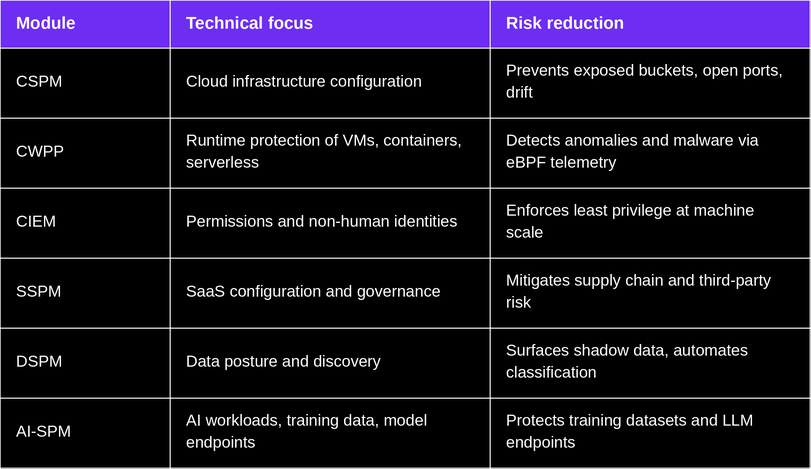
Protecting modern applications requires visibility that runs from source code to production runtime. CNAPP platforms answer that need by consolidating tools previously sold and managed as independent silos: CSPM for cloud posture, CWPP for workload runtime, CIEM for permissions and non-human identities, SSPM for SaaS configuration, DSPM for data posture, and now AI-SPM for the security of AI workloads themselves. The strategic value of CNAPP is not the sum of these modules. It is the correlation between them.
Mature CNAPP platforms are measured on their ability to perform attack path analysis. A misconfigured cloud instance (a CSPM signal) that holds an over-privileged IAM role (a CIEM signal) and runs a workload with a critical runtime vulnerability (a CWPP signal) is no longer one of ten thousand alerts. It is a single prioritized attack path, scored for exploitability and blast radius. Lifecycle-aware integration extends these signals into the CI/CD pipeline through Infrastructure-as-Code scanning, container image analysis, and policy gates that block a build before it reaches production. Runtime telemetry, increasingly collected through kernel-level eBPF probes, gives the SOC depth of observation without invasive agents or sidecars.
Strategic implication. Fifteen years of accumulated security tools are now consolidating into a single fabric. The platform that produces fewer but smarter alerts is also the one that lets your SOC scale to the volume of agentic activity now arriving. NEVERHACK’s managed SOC and MSSP services are built for exactly that correlation-first model.
4. The AI supercycle: when half your workforce is a machine
The most consequential shift of the cycle is the move from generative AI as a co-pilot to agentic AI as an autonomous actor. Generative models, used reactively, fit reasonably well into the existing security model. Agentic systems do not. An agent plans multi-step tasks, calls tools, queries databases and triggers transactions on behalf of its human owner. The traits that make agentic systems efficient, namely long-term memory, tool use and strategic planning, are exactly the traits that make them dangerous when subverted: an attacker who manipulates an agent inherits all of those capabilities at machine speed.
The enabling layer of this transition is the Model Context Protocol (MCP), often described as the USB-C of AI: an open standard that lets clients connect to servers exposing enterprise data, tools and APIs. The convenience is enormous, and so is the visibility problem. Security tools built for browser and VPN traffic are effectively blind to MCP, and machine-to-machine flows happen at speeds and volumes that outpace a human SOC.
Four threat categories define the new perimeter: data exfiltration through uninspected prompts, tool poisoning that turns automation into an infection vector, credential leaks in agent initialization handshakes, and multi-turn jailbreaks that defeat single-prompt filters.
Closing this non-human gap takes two functional controls now recognized in analyst taxonomies. An Agentic Broker sits on the north-south path between AI clients and external MCP servers: it decodes the protocol, discovers endpoints, applies a risk score, enforces DLP on outbound flows and produces a forensic audit trail.
An LLM Gateway sits on the east-west path between internal applications and private models, enforcing authentication and microsegmenting access to sensitive models.
Both depend on inline semantic inspection, which is why inference is moving to the edge: SASE platforms are embedding specialized hardware, including GPUs, directly into their PoPs so that prompt analysis can run inline at multi-gigabit speed.
5. API Security and the AI firewall: the new application edge
APIs have become the dominant attack vector in cloud-native environments. Industry telemetry recorded a 33% rise in attacks against web applications and APIs in 2024, and the implication is structural: APIs are no longer one attack surface among many, they are the surface. Static edge filtering stops being enough once traffic includes machine-to-machine calls, agent-to-tool invocations and LLM endpoints whose payloads are semantic rather than syntactic.
Modern API security platforms combine three disciplines that used to be separate. Discovery finds shadow and zombie APIs, including endpoints connected to GenAI and MCP servers. Posture analysis assesses authentication strength, PII exposure, and policy compliance. Runtime protection inspects behavior, catching abuse, scraping, account takeover and credential stuffing in real time. The leading edge of the category is now shift-left discovery: identifying API vulnerabilities and MCP server definitions directly in source repositories, before an endpoint is ever deployed.
The AI Firewall extends this into territory that did not exist five years ago. Input inspection analyzes prompts in real time for jailbreaks, prompt injection and unauthorized queries. Output filtering monitors AI-generated responses to prevent leakage of intellectual property, PII or trade secrets, and to sanitize toxic content and high-confidence hallucinations before they reach users. Both depend on inline semantic analysis, which is again why GPU-accelerated edge inference matters: without it, the latency penalty would be unacceptable. One subtler risk sits underneath all of this. Model inversion attacks can statistically reconstruct the sensitive data used in training by studying a model’s responses, and once regulated data is absorbed into a neural network’s weights, deleting it on request is technically hard and rarely cheap. Differential privacy and rigorous data classification before training are the only architectural defenses that survive contact with the right to be forgotten.
Strategic implication. If your WAF still operates only on signatures, it is structurally unable to see the threats most likely to compromise your AI services. The investment question is twofold: can your API security platform discover shadow AI endpoints, inspect MCP traffic and apply semantic filters without breaking the latency budget? And does your training governance treat pre-training data with the same care you would give an export to a system you can never delete from?
6. The fused architecture: when SASE meets CNAPP
The strategic destination of the cycle is the integrated fabric where SASE and CNAPP stop being separate disciplines and become a single operational substance. In this fused architecture, the line between network security and application security dissolves. The protected entity is no longer a user, a device, a container or an API in isolation. It is the end-to-end business flow, secured through identity-based micro-segmentation that does not care whether the traffic is north-south or east-west, human or agentic, on-premises or multi-cloud. AI agents move from anomaly detection to autonomous remediation, executing containment and rollback at machine speed.
Strategic implication. Multi-vendor proliferation is no longer a sign of maturity. It is the attack surface you cannot govern. The investment thesis for the next 18 months is simple: consolidate onto a platform that fuses SASE, CNAPP and AI controls under a single identity and policy model, before agentic activity in your organization outruns the visibility of your current stack.
Conclusion: who is really in control?
Every architectural shift in this analysis points the same way. Security is moving from perimeter, to identity, to behavior, to intent. The protected unit is no longer a network segment or even a user. It is a decision: a piece of business logic, increasingly taken by an autonomous system, in milliseconds, on your behalf.
The priorities for the next 18 months are concrete: adopt unified single-vendor SASE and retire chained appliances; complete the migration from VPN to Universal ZTNA, including legacy and OT systems.
Deploy lifecycle-aware CNAPP wired into CI/CD with eBPF runtime telemetry; establish agentic AI governance with an Agentic Broker for outbound MCP traffic and an LLM Gateway for east-west AI traffic; and treat AI-SPM, AI BOM and pre-training data classification as budget lines rather than compliance exercises.
These are not security checkboxes. They are the operating models of an organization that intends to keep control of its own decision-making in an environment where most of those decisions are no longer made by humans.
If a machine agent inside your environment takes an action you did not authorize, can your security architecture explain why it did so, fast enough to stop the next one? If the answer is no, who is really in command?